 Swears of the World
Irish Slang
From eejit to banjaxed, Hiberno-English is some of the most colourful language on earth. Here's a free A–Z dictionary of 115 real Irish slang words and phrases — what each one means, how to say it, and how it's actually used.
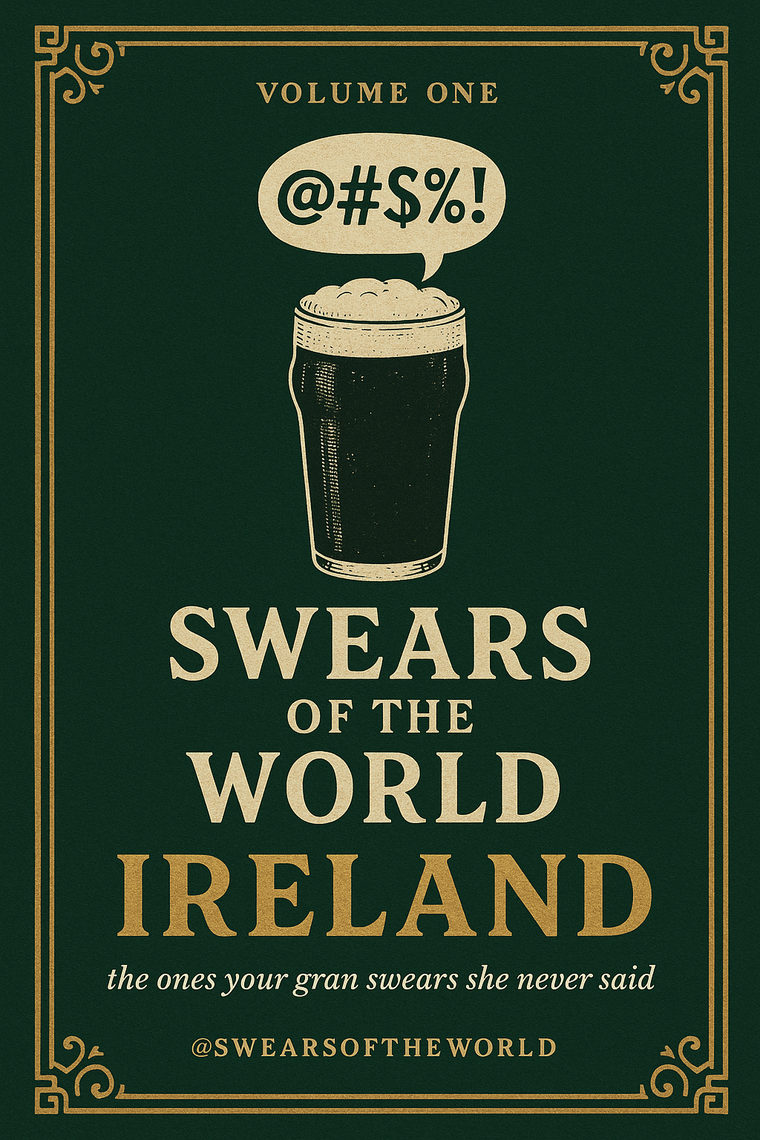
All 115+ entries, illustrated & uncensored — instant ebook.
Get the ebook · $5 Play freeA
- Acting the b*llocks/ˈæktɪŋ ðə ˈbɒləks/phrase
- Behaving like an idiot; messing about and being deliberately difficult — a spicier sibling of 'acting the maggot'.
“Quit acting the bollocks and help me carry this.”
- Acting the maggot/ˈæktɪŋ ðə ˈmæɡət/phrase
- Messing about, misbehaving or being deliberately foolish — usually in a harmless, playful way.
“Stop acting the maggot and finish your dinner.”
- Amadán/ˈɑːmədɑːn/noun
- A fool or idiot. Borrowed straight from the Irish language and used in English speech, from gentle teasing to a real insult depending on tone.
“Will you stop, ya big amadán.”
- Arseways/ˈɑːrsweɪz/adjective · adverb
- Backwards, wrong, or in a complete muddle. 'It all went arseways' means it went badly awry.
“The whole plan went arseways at the last minute.”
- Away in the head/əˈweɪ ɪn ðə hɛd/phrase
- Confused, foolish or not all there — chiefly Northern. 'You're away in the head' = you're talking nonsense / you're mad.
“Pay two hundred quid for that? You're away in the head.”
B
- Bake/beɪk/noun
- The face or mouth — chiefly Ulster/Northern. 'Shut your bake' means be quiet.
“Wipe that grin off your bake.”
- Baltic/ˈbɔːltɪk/adjective
- Extremely cold. 'It's Baltic out' is the standard verdict on an Irish winter's day.
“Wrap up, it's absolutely Baltic out there.”
- Banjaxed/ˈbændʒækst/adjective
- Broken, ruined or wrecked — beyond repair. Also said of a person who is exhausted.
“The washing machine's banjaxed again.”
- Bockety/ˈbɒkɪti/adjective
- Wobbly, unsteady or lopsided — said of a wonky table, a limping gait, or anything not quite right.
“Mind that chair, it's a bit bockety.”
- Bold/boʊld/adjective
- Naughty or badly behaved — said especially of children (and dogs). Not 'brave' in this sense. 'You're very bold' is a telling-off.
“Santa doesn't come to bold children.”
- B*llixed/ˈbɒlɪkst/adjective
- Broken, ruined or messed up; also exhausted. A variant of 'banjaxed' built on 'bollix/bollocks'.
“The laptop's bollixed, it won't even turn on.”
- B*llocks/ˈbɒləks/noun · exclamation
- Testicles; also nonsense ('that's bollocks'), a disaster ('we made a bollocks of it'), or a contemptible person — context decides which.
“Ah bollocks, there goes the bus.”
- Bowsie/ˈbaʊzi/noun
- A worthless, low or untrustworthy person; a rowdy good-for-nothing — often a familiar face in the local pub.
“That bowsie still owes me a tenner from Christmas.”
- Bucketing/ˈbʌkɪtɪŋ/verb (gerund)
- Raining very heavily. 'It's bucketing (down)' — as if poured from a bucket.
“We can't go out, it's bucketing down.”
C
- Chancer/ˈtʃɑːnsər/noun
- An opportunist or risk-taker who tries to get away with things through bluff and cheek rather than honest effort.
“He charged us double — the chancer.”
- Chiseler/ˈtʃɪzlər/noun
- A child — old Dublin slang. 'The chiselers' are the kids.
“Mind the chiselers while I run to the shop.”
- Class/klɑːs/adjective
- Excellent, great, brilliant. 'That's class' is straightforward approval.
“The new place is class, you'd love it.”
- Cop on/kɒp ɒn/phrase · noun
- Common sense, or the imperative to acquire some. 'Cop on!' means wise up / catch yourself on. 'He has no cop-on' means he's clueless.
“Cop on to yourself and apologise.”
- Craic/kræk/noun
- Fun, good times, lively conversation and atmosphere. 'What's the craic?' is a greeting; 'great craic' is the highest praise for a night out.
“The session in the pub was mighty craic altogether.”
- Culchie/ˈkʌltʃi/noun
- A person from rural Ireland or outside the cities. Mildly mocking from a townie, but often worn with pride by the culchies themselves.
“He's a culchie from the back arse of nowhere, but sound as a pound.”
- Cute/kjuːt/adjective
- In Ireland 'cute' usually means shrewd, sly or cunning — not adorable. A 'cute' operator looks after number one. (See also 'cute hoor'.)
“He's too cute to ever pay full price.”
- Cute h*or/kjuːt hʊər/noun
- Looks rude, isn't really an insult: a sly, cunning person who works the angles for their own advantage — admired and distrusted in equal measure. 'Cute' here means shrewd, not adorable.
“He bought the land before the rezoning — a proper cute hoor.”
D
- Deadly/ˈdɛdli/adjective
- Excellent, brilliant, great — a strong term of approval with nothing lethal about it.
“You got tickets? Deadly!”
- Delira/dɪˈlɪrə/adjective
- Delighted. Almost always paired as 'delira and excira' (delighted and excited).
“She got the job — she's delira and excira.”
- Delph/dɛlf/noun
- Crockery; dishes, plates and cups generally. 'Wash the delph' means do the dishes.
“Give me a hand drying the delph.”
- Donkey's years/ˈdɒŋkiz jɪərz/phrase
- A very long time. 'I haven't seen him in donkey's years.'
“Sure I've known her donkey's years.”
- Drysh*te/ˈdraɪʃaɪt/noun
- A dull, boring person with no sense of fun — the wet blanket of any gathering.
“Come out for one, don't be a dryshite.”
E
- Eat the head off/iːt ðə hɛd ɒf/phrase
- To verbally lay into someone; to scold or shout at them fiercely.
“She ate the head off me for being five minutes late.”
- Eejit/ˈiːdʒɪt/noun
- An idiot or fool — but usually said with affection rather than malice.
“Ya great eejit, you've put diesel in the petrol car.”
- Effin' and blindin'/ˈɛfɪn ən ˈblaɪndɪn/phrase
- Swearing profusely; cursing up a storm. A polite way to report that someone was using a lot of bad language.
“He was effin' and blindin' at the referee the whole match.”
F
- Feck off/fɛk ɒf/phrase
- A softened 'get lost' — the polite-ish dismissal that's just about printable. Can be aggressive or affectionate depending entirely on tone.
“Ah feck off, you're winding me up.”
- Feckin'/ˈfɛkɪn/adjective
- A milder, more socially acceptable stand-in for the f-word — strong enough to vent, soft enough for the dinner table.
“Where's the feckin' remote gone now?”
- Fella/ˈfɛlə/noun
- A man or guy; also a boyfriend ('me fella'). 'The young fella' is one's son or any young lad.
“Ask that fella behind the bar.”
- Fierce/fɪərs/adverb · adjective
- Very, extremely. 'Fierce warm', 'fierce nice' — an all-purpose intensifier, not actual ferocity.
“It's fierce mild for January.”
- Fluthered/ˈflʌðərd/adjective
- Very drunk; intoxicated.
“We were all fluthered by the end of the wedding.”
- Fooster/ˈfuːstər/verb
- To fuss, fumble or potter about ineffectually — the base verb behind 'foostering'.
“He's still foostering with the wires.”
- Foostering/ˈfuːstərɪŋ/verb (gerund)
- Fiddling, fussing or messing about ineffectually — busy activity that gets nowhere.
“Stop foostering with that phone and listen.”
- Footpath/ˈfʊtpɑːθ/noun
- The pavement / sidewalk — the standard word in Ireland (not 'sidewalk' or, usually, 'pavement').
“Mind the cyclist on the footpath.”
- Foundered/ˈfaʊndərd/adjective
- Frozen / very cold (Ulster). 'I'm foundered' means I'm perished with the cold.
“Come in out of that, you must be foundered.”
G
- Gaff/ɡæf/noun
- Home, house or flat. A 'free gaff' (parents away) is a teenage rite of passage.
“We're heading back to my gaff after the pub.”
- Gas/ɡæs/adjective · noun
- Very funny or amusing. A 'gas character' is a hilarious one; 'that's gas' means that's a great laugh.
“Your man telling that story — he's pure gas.”
- Gas man/ɡæs mæn/noun
- A funny, entertaining fellow — a 'character'. (Nothing to do with the utility company.)
“Ah he's a gas man, the life of the party.”
- G*ebag/ˈɡiːbæɡ/noun
- A disparaging term for an objectionable or unpleasant person — most often aimed at a woman. Listed as a documented dialect word; the field guide records it, it does not recommend pointing it at anyone.
“(Recorded usage) said of a person regarded as nasty or annoying.”
- Give out/ɡɪv aʊt/phrasal verb
- To scold, complain or tell someone off. 'Giving out' is a national pastime; 'giving out yards' means doing it at length.
“Mam was giving out to me for being late again.”
- Gob/ɡɒb/noun
- The mouth. 'Shut your gob' means be quiet; 'gobful' is an earful.
“He never shuts his gob for a second.”
- Gobdaw/ˈɡɒbdɔː/noun
- A foolish, gullible or pretentious person of no real substance.
“Don't be listening to that gobdaw.”
- Gobsh*te/ˈɡɒbʃaɪt/noun
- A stupid or contemptible person, especially one who talks confident nonsense. Literally 'mouth-shite' (gob = mouth).
“Don't mind him, sure he's only an awful gobshite.”
- Gobsmacked/ˈɡɒbsmækt/adjective
- Astonished, dumbfounded — as if smacked in the mouth ('gob') by the surprise.
“I was gobsmacked when they announced the winner.”
- Gombeen/ɡɒmˈbiːn/noun · adjective
- A shady, self-serving small-time operator or wheeler-dealer — classically a 'gombeen man', a grasping money-lender or politician out for himself.
“The whole scheme reeks of gombeen politics.”
- Gowl/ɡaʊl/noun
- A foolish or contemptible person — chiefly Limerick and the north. It also carries a cruder anatomical sense, which is the source of its bite.
“He locked the keys in the car, the gowl.”
- Grand/ɡrænd/adjective
- Fine, okay, satisfactory — rarely 'grand' in the lavish sense. The national word for 'it'll do'. 'I'm grand' can mean anything from genuinely well to politely declining help.
“Don't worry about it, sure it's grand.”
- Grand so/ɡrænd soʊ/phrase
- 'Okay then' / 'that's settled' — a sign-off agreeing to something. The 'so' at the end is a classic Hiberno-English tag.
“We'll meet at eight? Grand so.”
- Grand stretch in the eveningsɡrand strech in thə EEV-ningsphrase
- The seasonal observation that the days are getting longer as spring approaches — a near-compulsory remark from February onward.
“There's a grand stretch in the evenings now, thank God.”
- Gurrier/ˈɡʌriər/noun
- A rough, tough or unruly young man; a hooligan or troublemaker. Chiefly Dublin.
“A pack of gurriers were throwing stones at the bus.”
H
- Header/ˈhɛdər/noun
- A wild, unpredictable or slightly mad person — often said with grudging affection. 'He's an absolute header.'
“That fella's a header, you never know what he'll do.”
- Hooley/ˈhuːli/noun
- A lively party, knees-up or celebration with music and dancing. 'We had a great hooley.'
“There was a mighty hooley in the house after the match.”
- Hop off/hɒp ɒf/phrasal verb
- To pick a fight with, provoke or take a verbal go at someone. 'Don't be hopping off me' means leave me alone.
“He started hopping off the ref over the decision.”
- Howaya/həˈwaɪə/interjection
- 'How are you?' compressed into a single word and used as a greeting, not a real question. Strongly Dublin.
“Howaya, haven't seen you in ages!”
J
- Jackeen/dʒæˈkiːn/noun
- A Dubliner — used (mildly mockingly) chiefly by rural Irish people. The country cousin of 'culchie', aimed back at the capital.
“Typical jackeen, doesn't know one end of a cow from the other.”
- Janey Mac/ˈdʒeɪni mæk/interjection
- A mild exclamation of surprise — a clean stand-in for stronger oaths. 'Janey Mac, the price of that!'
“Janey Mac, would you look at the size of it!”
- Jaysus/ˈdʒeɪzəs/interjection
- The Irish pronunciation-spelling of 'Jesus', used as an all-purpose exclamation of surprise, frustration or emphasis.
“Ah Jaysus, not again.”
K
- Knackered/ˈnækərd/adjective
- Exhausted, worn out, very tired. 'I'm absolutely knackered' after a long day.
“I'm knackered, I'm going straight to bed.”
L
- Langer/ˈlæŋɡər/noun
- A fool, idiot or contemptible person — the signature Cork insult. It also has a cruder anatomical meaning (penis), which is where the heat comes from.
“He cut the whole queue, the absolute langer.”
- Langered/ˈlæŋɡərd/adjective
- Very drunk — especially associated with Cork. (Related to 'langer'.)
“He was langered before the band even started.”
- Langers/ˈlæŋɡərz/adjective
- Very drunk — the Cork form (related to 'langered'). 'I was langers last night.'
“The pair of them were langers after the rugby.”
- Lashing/ˈlæʃɪŋ/verb (gerund)
- Raining hard; 'lashing rain' is a downpour. (Distinct from 'on the lash', which is drinking.)
“It's lashing out there, take the umbrella.”
- Leg it/lɛɡ ɪt/phrase
- To run away fast, to flee. 'We legged it when the bus came.'
“Leg it, the bus is pulling out!”
- Locked/lɒkt/adjective
- Very drunk.
“He was locked by nine o'clock.”
- Ludramán/ˈluːdrəmɑːn/noun
- A lazy, useless or idle fool; a layabout.
“Get up off the couch, ya ludramán.”
M
- Make a hames of/meɪk ə ˈheɪmz əv/phrase
- To botch something completely; to make a total mess of a task.
“They made a right hames of the new road layout.”
- Manky/ˈmæŋki/adjective
- Dirty, filthy or disgusting; also rotten or in poor condition.
“Those runners are absolutely manky, give them a wash.”
- Massive/ˈmæsɪv/adjective
- Great, brilliant, fantastic — nothing necessarily to do with size. Especially heard in the north.
“Your new haircut is massive.”
- Melter/ˈmɛltər/noun
- A person so relentlessly annoying they 'melt your head' — wear you down with talk or nagging.
“She's been textin' all day — what an absolute melter.”
- Messages/ˈmɛsɪdʒɪz/noun
- Shopping or errands. 'Doing the messages' means doing the grocery run, not texting.
“I'm off to do the messages, need anything?”
- Mighty/ˈmaɪti/adjective
- Great, excellent, enjoyable — 'twas mighty' is a fine review of any night out.
“The trad session was mighty altogether.”
- Minerals/ˈmɪnərəlz/noun
- Soft drinks; fizzy non-alcoholic drinks. 'Will you have a mineral?' is a kind offer of a soda.
“Get the kids a few minerals from the shop.”
- Mitch/mɪtʃ/verb
- To play truant; to skip school without permission. 'Mitching off school.'
“They were caught mitching down at the river.”
- Mortified/ˈmɔːrtɪfaɪd/adjective
- Acutely embarrassed or humiliated — a close cousin of 'scarlet', used with great frequency.
“I was mortified when my phone rang at the funeral.”
- Mot/mɒt/noun
- Girlfriend (sometimes wife). 'Me mot' is Dublin for 'my girlfriend'. Also spelt 'moth'.
“He's bringing his mot to the wedding.”
N
- Naggin/ˈnæɡɪn/noun
- A small 200ml bottle of spirits — the pocket-sized format famous for fitting neatly into a sock or jacket.
“Smuggled a naggin into the disco, didn't I.”
- Notions/ˈnoʊʃənz/noun
- Pretensions or airs above one's station. 'She has notions' means she's gotten above herself or developed fancy tastes.
“Olives in the house now — he's got some notions.”
O
- On the lash/ɒn ðə læʃ/phrase
- Out drinking heavily; on a session of pub-going.
“We're on the lash for Dave's stag this weekend.”
- Ossified/ˈɒsɪfaɪd/adjective
- Extremely drunk — so far gone you've gone stiff. One of the more poetic entries in the Irish drunk-lexicon.
“By midnight the whole stag party was ossified.”
P
- Plámás/ˈplɑːmɑːs/noun
- Smooth, flattering, soft-soaping talk — empty praise designed to butter someone up.
“Don't mind his plámás, he just wants a favour.”
- Press/prɛs/noun
- A cupboard or storage closet. The 'hot press' is the airing cupboard around the boiler — a peculiarly Irish institution.
“The good towels are in the hot press.”
- Pure/pjʊər/adverb
- Completely, totally — used as an intensifier. 'Pure delighted', 'pure raging'. Strongly Cork/Munster.
“I'm pure thrilled with the new car.”
Q
- Quare/kwɛər/adjective · adverb
- A dialect form of 'queer' meaning strange — but also an intensifier ('quare good', meaning very good). Common in Ulster and rural speech.
“That's a quare big spud you've grown.”
- Quare hawk/kwɛər hɔːk/noun
- An odd or eccentric character; a strange one. 'He's a quare hawk' marks someone as peculiar but not necessarily unlikeable.
“Your man's a quare hawk, but harmless.”
- Quench/kwɛntʃ/verb
- To turn off or extinguish a light or appliance. 'Quench the light' means switch it off. Chiefly rural/Munster.
“Quench that light, we're going to bed.”
R
- Ride/raɪd/noun · verb
- Two senses: (1) a very attractive person ('he's a fine ride'), used as a compliment; (2) the cruder verb for sex. The compliment sense is the everyday one.
“Your one off the telly is an absolute ride.”
- Runners/ˈrʌnərz/noun
- Trainers or sneakers; athletic shoes.
“Put on your runners, we're walking.”
S
- Savage/ˈsævɪdʒ/adjective
- Very good, great or impressive. 'Savage' food is delicious; a 'savage' match is a brilliant one.
“That feed was savage, fair play to the chef.”
- Scarlet/ˈskɑːrlɪt/adjective
- Mortified or deeply embarrassed — often felt on someone else's behalf. 'Scarlet for ya.'
“He sang at the wedding. I was scarlet for him.”
- Scarper/ˈskɑːrpər/verb
- To run off or make a hasty escape, often to avoid trouble or paying.
“They scarpered before the bill came.”
- Scundered/ˈskʌndərd/adjective
- Embarrassed or mortified (Ulster); in some Northern usage also fed up or disgusted. The Northern cousin of 'scarlet'.
“I was scundered when I tripped in front of everyone.”
- Scuttered/ˈskʌtərd/adjective
- Very drunk — especially common in Munster.
“He came home scuttered after the match.”
- Shift/ʃɪft/noun · verb
- To kiss or make out with someone, especially at a disco or nightclub. 'Did you get the shift?' has nothing to do with work rosters.
“He was trying to shift half the room at the disco.”
- Sh*te/ʃaɪt/noun · interjection
- The Irish (and northern British) pronunciation of 'shit'. Used for nonsense ('that's a load of shite'), bad quality, or as a general exclamation.
“Ah shite, I left the keys inside.”
- Sleeveen/sliːˈviːn/noun
- A sly, smooth-talking, untrustworthy person; a sneak who flatters to your face and works against you behind your back.
“That sleeveen would smile at you while robbing your pocket.”
- Slán/slɑːn/interjection
- Goodbye (literally 'safe', as in 'safe home'). The everyday Irish-language farewell, used even in English speech.
“Right, I'm off — slán!”
- Soft day/sɒft deɪ/phrase
- A mild, misty, drizzly day — the gentle, all-day damp peculiar to Ireland. 'A soft day, thank God.'
“Sure it's only a soft day, you'll not melt.”
- Sound/saʊnd/adjective
- Decent, reliable and good-natured. A 'sound' person is someone you can count on; 'sound' on its own can also just mean 'thanks/okay'.
“He gave me a lift home, he's dead sound.”
- Spanner/ˈspænər/noun
- A fool or idiot; someone behaving stupidly. 'Ya spanner, ya' — light-hearted abuse.
“He locked himself out again, the spanner.”
T
- The craic was ninety/ðə kræk wəz ˈnaɪnti/phrase
- The fun was at full tilt; a brilliant, lively time was had. 'The craic was ninety' = it was an unbeatable session.
“We were up till four — the craic was ninety.”
- The h*rn/ðə hɔːrn/noun
- Sexual arousal. 'He has the horn' means he's feeling randy. A tease for the feed; the franker entries are book-only.
“(Cleaned up) 'Two pints in and he has the horn.'”
- The jacks/ðə dʒæks/noun
- The toilet or lavatory. 'I'm off to the jacks' is the standard announcement.
“Where's the jacks in this place?”
- Thick/θɪk/adjective
- Stupid — but in Ireland also bad-tempered, sulky or stubborn. 'Don't be getting thick with me' means don't get cross.
“He went all thick when I corrected him.”
W
- Wag*n/ˈwæɡən/noun
- A disparaging term aimed at a woman regarded as difficult, unpleasant or sharp-tongued. Included here as a documented piece of the dialect — the entry observes the word, it does not endorse aiming it at anyone.
“(Recorded usage) 'She's an awful wagon' — said of a difficult person.”
- What's the story/wɒts ðə ˈstɔːri/phrase
- A casual greeting meaning 'what's up?' or 'how are things?'. Can also genuinely ask 'what's going on here?'.
“Howaya, what's the story?”
- Whisht/wɪʃt/interjection
- Be quiet; hush. 'Hold your whisht' or just 'Whisht!' means shut up / stop talking.
“Whisht now, the news is on.”
- Wile/waɪl/adverb · adjective
- Very, extremely (Ulster/Donegal). 'Wile good', 'wile cold' — an intensifier. Also can mean 'terrible'.
“It's wile cold up here in Donegal.”
- Wojus/ˈwoʊdʒəs/adjective
- Terrible, awful, very bad. 'The weather was wojus.'
“That film was absolutely wojus.”
Y
- Yer man/jɜːr mæn/phrase
- 'That fella' — a way of referring to a man whose name you don't know or won't say. The female counterpart is 'yer one'.
“Yer man over there keeps staring.”
- Yer one/jɜːr wʌn/phrase
- 'That woman' — the female counterpart to 'yer man', for a woman unnamed or unidentified.
“Yer one from the shop was asking after you.”
- Yoke/joʊk/noun
- A thing, gadget or whatsit — the catch-all word for any object whose name you can't recall.
“Hand me that yoke there for opening the tin.”